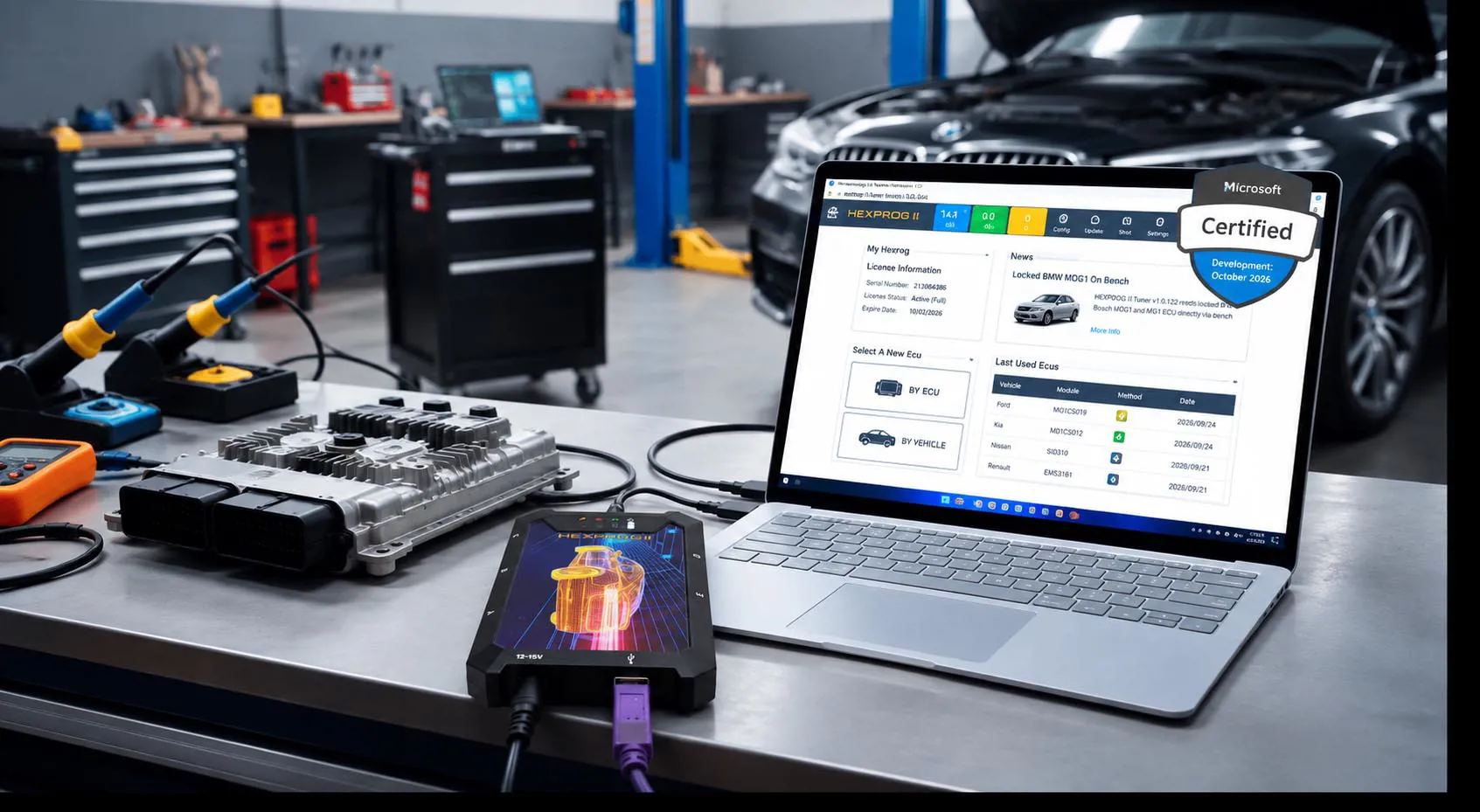
- From October 2026, every release of Hexprog II Tuner is compiled with Visual Studio 2026.
- You get a smaller install, faster startup and meaningfully better protection against memory-safety attacks with no change to how you work.
- Requirement change: Hexprog II Tuner will run on Windows 10 or Windows 11 only. Binaries produced after the migration will not start on Windows 7, 8 or 8.1.
- There is no legacy branch to fall back on. Hexprog II Tuner is a live tuning tool, and its value is new ECU coverage.
What is changing, and when
The compiler that turns our source code into the program on your desk is a tool like any other and, like any other tool, the current generation is sharper than the one before it.
In October 2026 we move our build pipeline to Visual Studio 2026, Microsoft's current development environment. This changes how Hexprog II Tuner is built, not what it does. Your workflows, your files and your hardware stay exactly as they are.
If your PC already runs Windows 10 or 11 and most of yours do you have nothing to do. Read on for what you'll notice.
What you get
A smaller program on disk
Modern compilers are far better at refusing to emit code that can never run, at merging duplicated logic, and at laying out the data structures behind error handling compactly.
That lands directly on your machine as a smaller download and a smaller installed footprint worth noticing when you install on a compact workshop laptop, an industrial panel PC, or a portable drive you carry between bench and car.
Faster startup and smoother execution
Two improvements, both felt rather than seen.
Start-up. There is simply less program for Windows to map into memory before the first screen appears. On mechanical drives and older workshop hardware, that is the difference you notice on the very first launch.
Day-to-day work. The newer compiler produces tighter, better-scheduled machine code and makes smarter decisions about what stays in the CPU's fastest memory. In practice that means lower CPU load during the heavy parts of a job large file handling, long data logging sessions, intensive calibration work so the interface stays responsive and laptops throttle less.
Rebuilding Hexprog II Tuner on the modern toolchain turns those mitigations on across the whole product including components written years ago under far weaker assumptions.
To be explicit: this is not a response to any known threat against Hexprog II Tuner. It is us keeping the product in line with what modern Windows expects of it.
Windows 10 or 11 is now a hard requirement
This is the part that needs your attention.
Visual Studio 2026 no longer targets Windows 7, 8 or 8.1 at all. Those operating systems have been removed from the toolchain's supported design the SDK headers, the libraries we link against and the runtime that every program depends on are all built against the Windows 10 and Windows 11 API surface.
That is not a licensing decision or a policy choice on our side. It is a structural one. The executable we produce calls functions that do not exist on Windows 7, 8 or 8.1, and links against a runtime that expects loader behavior those systems never had. There is no compatibility mode that fixes this, no setting you can change, and no patch we could ship.
In short: the program will not start on Windows 7, 8 or 8.1. The installer will detect the operating system and stop with a clear message rather than leave you with a half-working copy.
The other half of the picture is that Microsoft itself abandoned these operating systems long ago and we would be building on quicksand if we followed them there.
- Windows 7 support ended 14 January 2020.
- Windows 8.1 support ended 9 January 2023.
- Windows 8 (non-8.1) ended January 2016.
Windows 7 lost all support, including security updates, in January 2020. Windows 8.1 followed in January 2023. Windows 8 was retired even earlier. These are not recent retirements; Windows 7 has been unsupported for over six years now, and Windows 8.1 for three.
Running an unsupported Windows version in a workshop in 2026 means a machine that receives no security fixes, no driver updates and no protection against threats discovered after its retirement. Now connect that machine to vehicles, to a diagnostic port, and to files you sell for a living. Continuing to build commercial software for those platforms wouldn't be customer-friendly it would be negligent.
Dropping them lets us build Hexprog II Tuner on an operating system that is actually maintained, on hardware drivers that are actually updated, and against security standards that actually hold up.
Frequently asked questions
Why not stay on the old compiler forever?
Because its support ends regardless of what we choose. Runtime security fixes stop arriving and the operating systems hosting it disappear. Staying put doesn't avoid change it just means meeting it later with fewer options.
Can I keep my old version running on Windows 7?
It will keep running for as long as that machine stays intact, but it will receive no further ECU coverage and no security fixes. In a working tuning shop that's a stopgap measured in months, not a plan.
Is this because of a security problem in the current version?
No. There is no known vulnerability affecting Hexprog II Tuner. This is routine maintenance.
Will my existing read and write files still work?
Yes.
I'm on Windows 10 already do I need Windows 11?
No. Windows 10 remains supported.