Why this feature matters
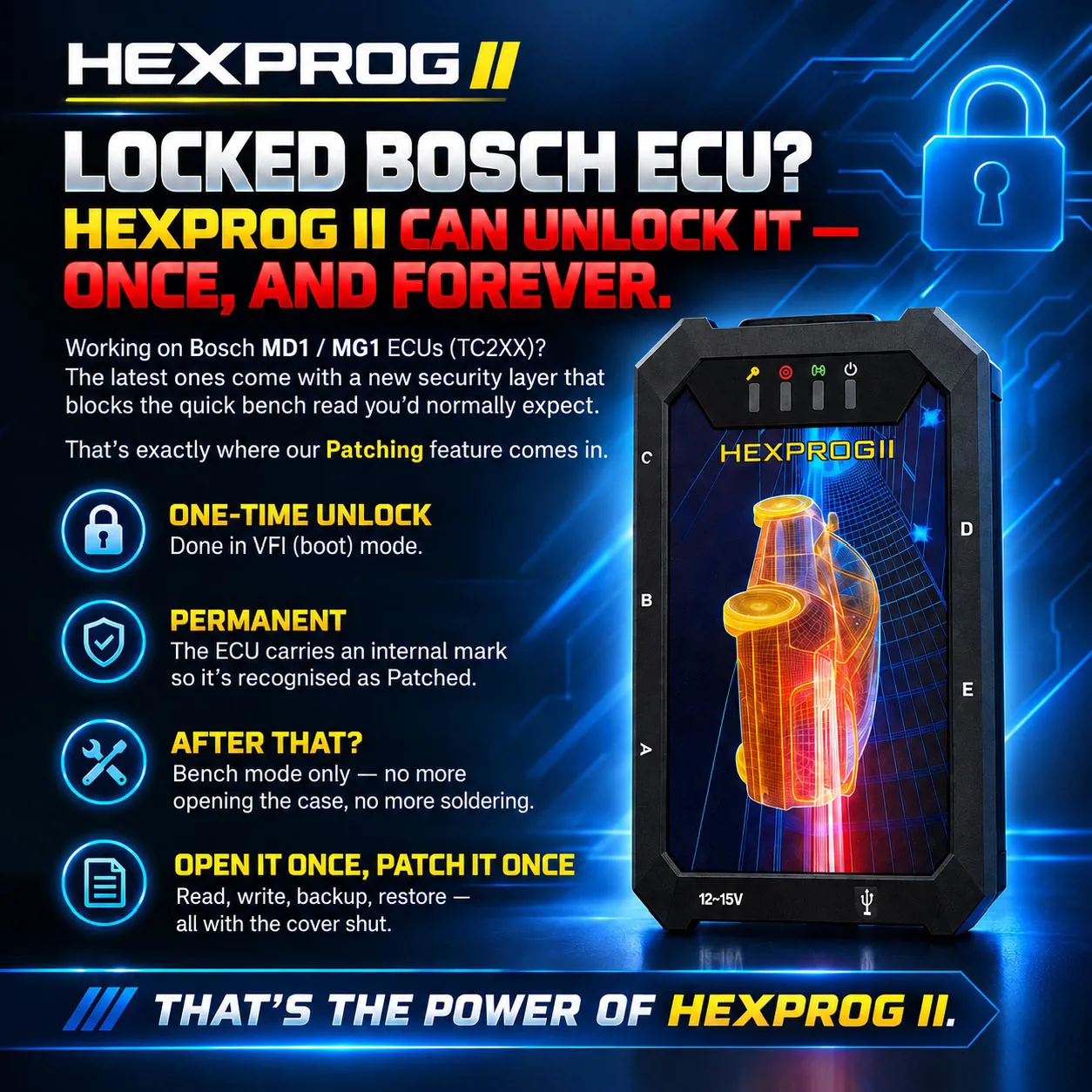
Bosch MD1 and MG1 engine control units built on the Infineon TC2XX (TriCore) family are some of the most common ECUs on modern petrol and diesel. They are fast, smart, and, in their latest revisions, protected by a new security layer that blocks the usual quick read you would expect on the workbench.
Hexprog II Tuner answers that protection with a dedicated Patching feature. In plain terms, Patching takes a locked MD1/MG1 and turns it into an ECU you can work with on the bench, forever, without ever opening the case again. It is a onetime operation, done in VFI (boot) mode, and once it is finished, the ECU carries an internal identification mark, so both you and the tool know it has already been handled. This article walks you through exactly what Patching does, when the tool will ask you to use it, and the step-by-step flow from a locked ECU to a permanent bench-ready one.
What "Patching" actually gives you
When a TC2XX-based MD1/MG1 is in its protected (locked) state, the ECU will not exchange flash data over the normal bench wiring. You can plug it in, but it simply refuses to cooperate. Patching is the procedure that lifts that protection. After a successful patch:
- The ECU is unlocked.
- The unlock is permanent you do it once, and you are done.
- Hexprog II writes a small identification mark inside the ECU so that, in the future, the tool instantly recognizes it as a Patched unit.
- From that moment on, every read, write, backup and restore can be done in Bench mode, with the cover closed and no soldering.
That last point is the real value: the first time you meet a locked MD1/MG1 you do a little work in Boot mode; every time after that, it behaves like any other bench ECU.
The two ways to connect: Bench vs Boot mode
Hexprog II gives you two connection paths, and Patching only lives in one of them.
Bench mode is the fast, no disassembly path. You connect the ECU through the bench harness, the cover stays shut, and you get the everyday operations: Read, Write, Backup and Restore. This is where a Patched (unlocked) ECU lives its working life. Note that the Patch function is not available here and there is no reason it should be: if the ECU is already patched, bench mode is all you need, and if it is locked, bench mode cannot patch it. You will only ever patch in Boot mode.
Boot mode is the path that requires opening the ECU and establishing a direct connection to the processor through the VFI module (the solder pad interface). This is the only place the Patch button appears, because unlocking a protected TC2XX ECU requires that low-level access. Boot mode also gives you Read, Write, Backup and Restore, but its unique job is to let you run the one-time patch.
So, the rule of thumb is simple: locked ECU → Boot mode to patch it once; patched ECU → Bench mode for everything else.
The two ECU states you will deal with
To follow the tool's messages, it helps to think of an MD1/MG1 as being in one of two relevant conditions:
- Locked – the new security is active, and there is no patch mark inside. This ECU only works for reading/writing when you are in Boot mode, and it is the ECU that needs to be patched.
- Already Patched – the identification mark is present. This ECU is unlocked and belongs to the bench.
Hexprog II checks which condition it is facing the moment you try an operation, and if you have picked the wrong mode, it tells you so within a few seconds.
The messages you may see (and what they mean)
When you press Read, Write or Patch, Hexprog II evaluates the ECU state against the selected mode in under about 5 seconds and, if something is mismatched, shows a red message with a reference code. There are three of them, and each one is just the tool saying, "you are in the right job but the wrong room."
Reference 17C New Security! Ecu needs Patching in Boot Mode.
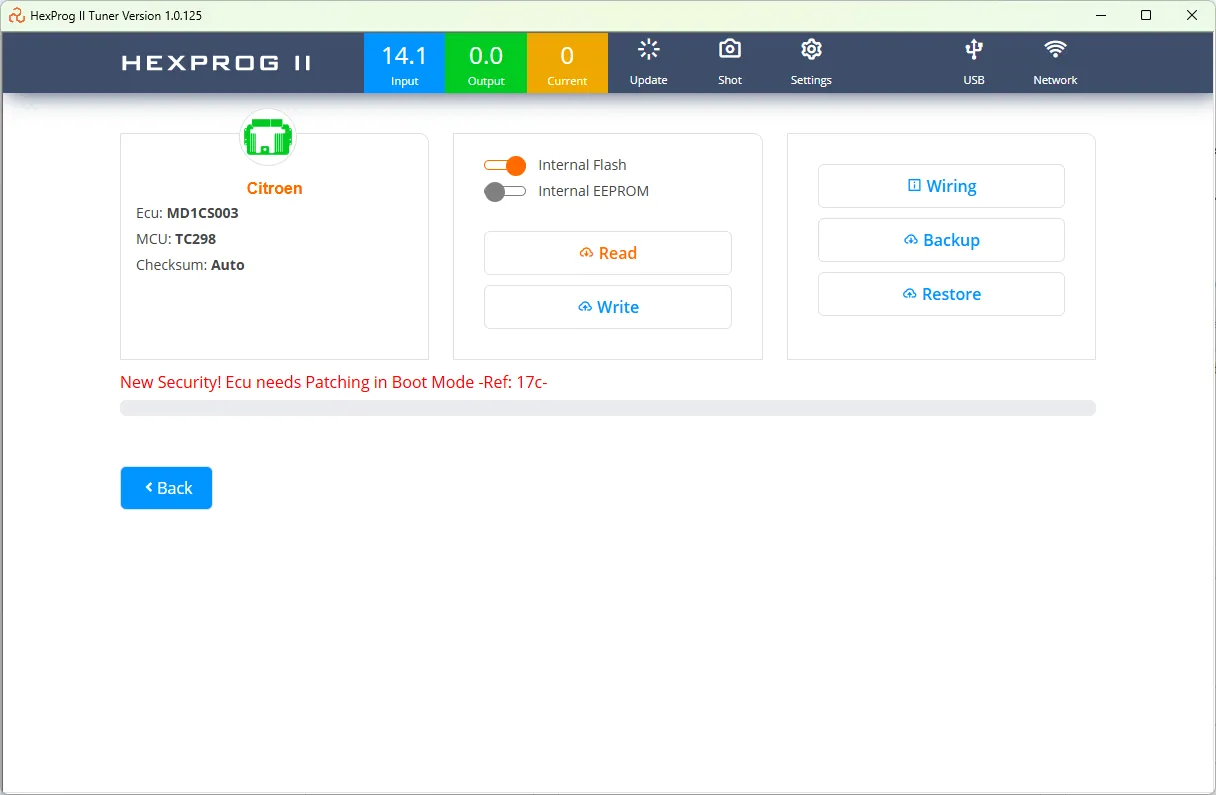
You see this when a locked ECU is connected in Bench mode. The bench wiring cannot get past the protection, so the tool stops you and points you to Boot mode. Nothing is wrong with your ECU you just need to open it, connect to the VFI module, and patch it once.
[Figure 1 – Bench mode on a locked ECU showing the 17C message]
Reference 9D4 Module does not need Patching, please use Bench Mode.
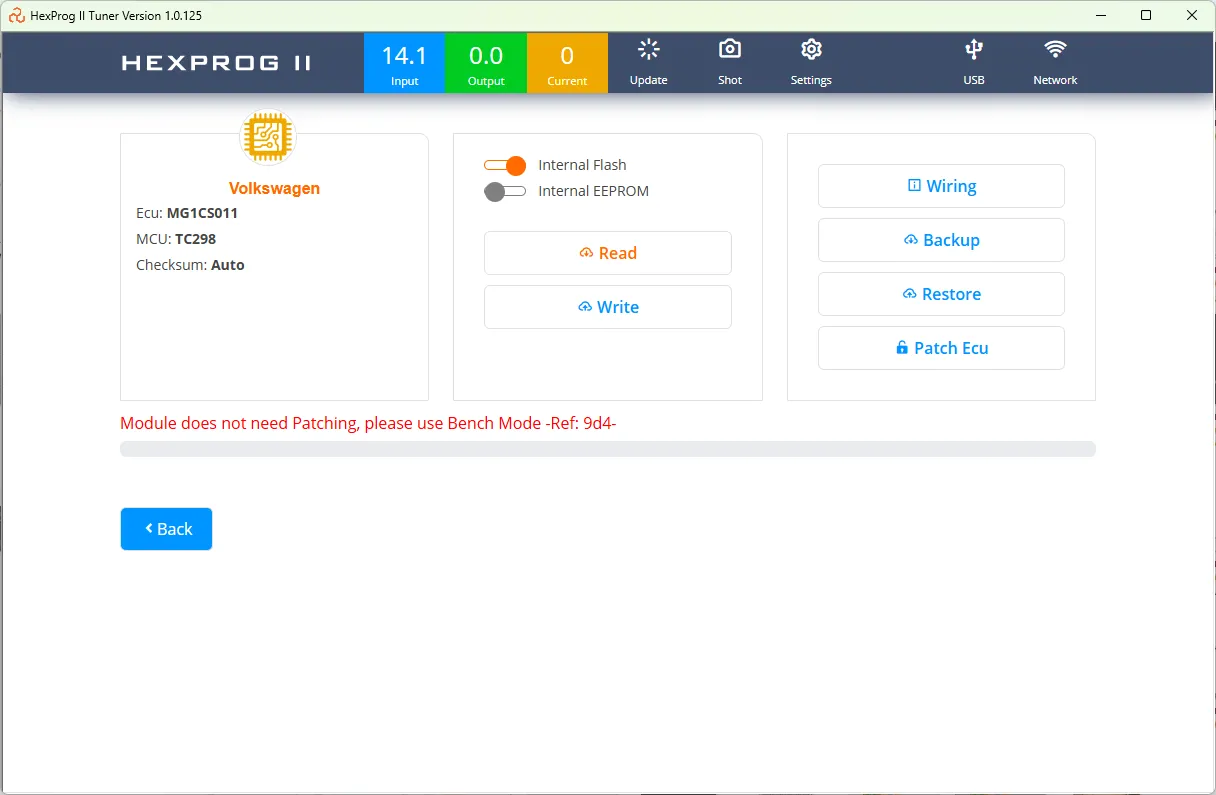
You see this in Boot mode when the tool finds no patch mark and no active lock i.e. an ECU that simply does not require patching but is connected in Boot mode anyway. The message is telling you there is no unlocking to do here; close up and use the bench.
[Figure 2 – VFI mode on an ECU that needs no patching, showing the 9D4 message]
Reference 9D3 Module is already Patched, please use Bench Mode.
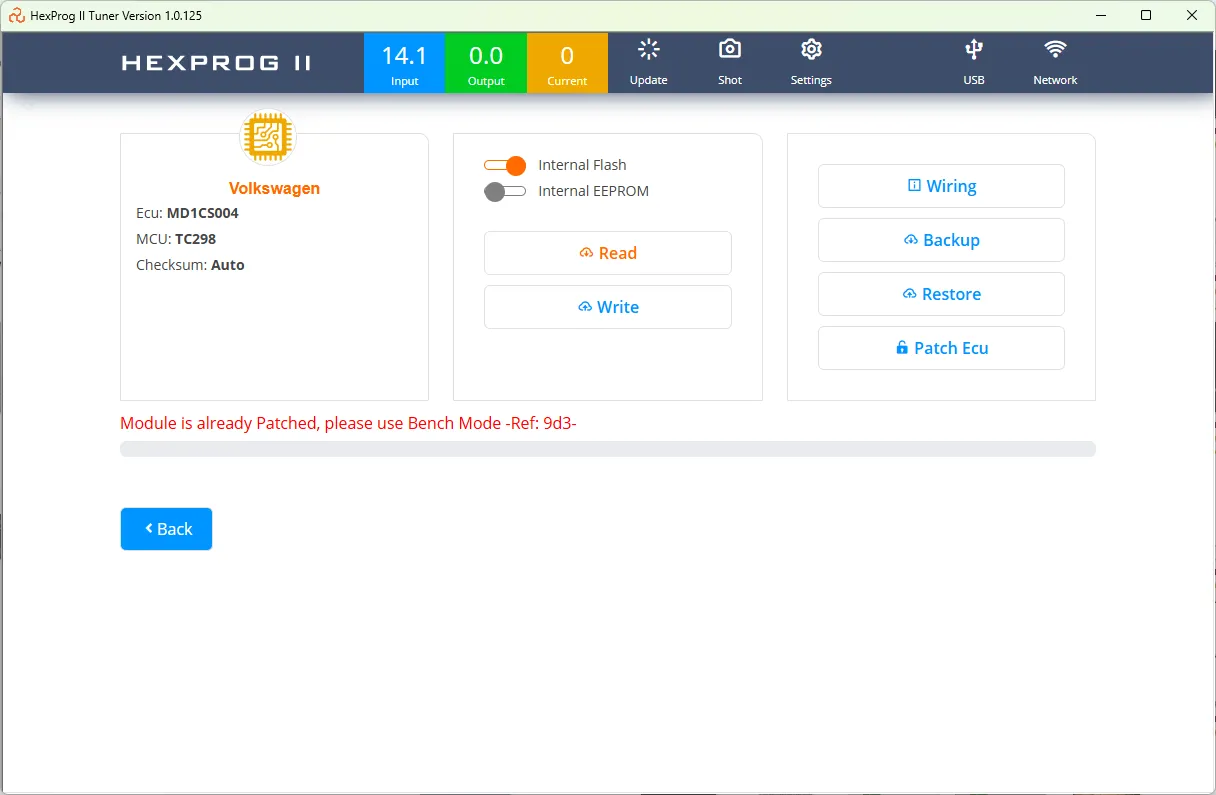
You see this in Boot mode when the identification mark is present the ECU has already been patched. Whether you press Read, Write or Patch again, the tool recognizes the mark and tells you the work is done: go to Bench mode and carry on. This is the message that confirms that the patch is permanent and that the tool remembers it.
[Figure 3 – VFI mode on an already-patched ECU showing the 9D3 message]
A correctly connected locked ECU in Boot mode, by contrast, shows no error at all the Read / Write / Patch options are simply live, waiting for you to run the patch.
[Figure 4 – VFI mode on a locked ECU, ready to patch, no message]
What you get after patching
After the single patch operation, the MD1/MG1 is transformed from a protected unit that demands disassembly into an ordinary bench ECU. Every future job tuning reads, writes, full backups and restores happens with the case shut. The internal mark means you never have to wonder whether a given ECU has been done connect it in Boot mode by mistake and Hexprog II will tell you, via 9D3, that it is already patched and belongs on the bench. One visit to the soldering iron buys your permanent bench access.
Good practice before you start
A few simple habits keep the process going smoothly. Always work with a stable, clean power supply and observe normal ESD precautions when the case is open. Double-check the VFI solder joints before pressing anything a flaky connection is the most common cause of a failed read. And always take and save a backup before any write, so you can return to the original file if needed. None of this is complicated; it is just the routine that protects the ECU and your work.
Quick troubleshooting
- "I plugged a locked ECU into the bench and got 17C." Expected. Open it, connect the VFI module, switch to Boot mode, and run Patch once.
- "I opened an ECU that didn't need patching and got 9D4." No harm done there was nothing to unlock. Close it and use Bench mode.
- "I tried to patch / read / write an ECU and got 9D3." That ECU is already patched. You are done with Boot mode; switch to Bench mode.
Conclusion
Patching is the feature that lets Hexprog II Tuner take the latest protected Bosch MD1/MG1 TC2XX ECUs and make them permanently bench friendly. A single, one-time unlocked in VFI mode protected by an internal identification mark converts a locked ECU into a closed-case, harness-only device for the rest of its service life. Open it once, patch it once, and from then on, the bench is all you need.
If you work on MD1/MG1 vehicles, this is the workflow that turns a fiddly, cover off job into a routine bench read and it is built right into Hexprog II.