Understanding Hardware Security Modules in Modern Automotive MCUs: Challenges and Solutions
The landscape of automotive electronics has undergone a profound transformation over the last decade.
For professionals involved in chip tuning, ECU remapping, and vehicle diagnostics using tools like Hexprog II, this shift represents both an evolution in technology and a significant change in workflow requirements. Central to this evolution is the widespread adoption of the Hardware Security Module (HSM) within modern Microcontroller Units (MCUs).
As manufacturers integrate stricter cybersecurity measures into Engine Control Units (ECUs), Transmission Control Units (TCUs), and other critical modules, understanding how these security islands function becomes essential for anyone working at the intersection of performance optimization and electronic maintenance.
This article aims to demystify the role of the HSM, explain its core functionalities, discuss the technical hurdles faced during reverse engineering efforts, and reaffirm our commitment to supporting you with advanced diagnostic solutions regardless of hardware complexity.
What Is a Hardware Security Module?
To understand the impact on your work, we must first define what an HSM actually is within the context of embedded systems architecture.
In traditional microcontrollers used in older vehicles, security features were often implemented through software protection bits or simple password checks stored directly in accessible memory sectors. While effective against casual tampering years ago, these methods are insufficient against sophisticated analysis techniques available today. Consequently, semiconductor vendors such as Infineon and NXP have integrated dedicated co-processors known as Hardware Security Modules directly onto the silicon die alongside the main CPU cores.
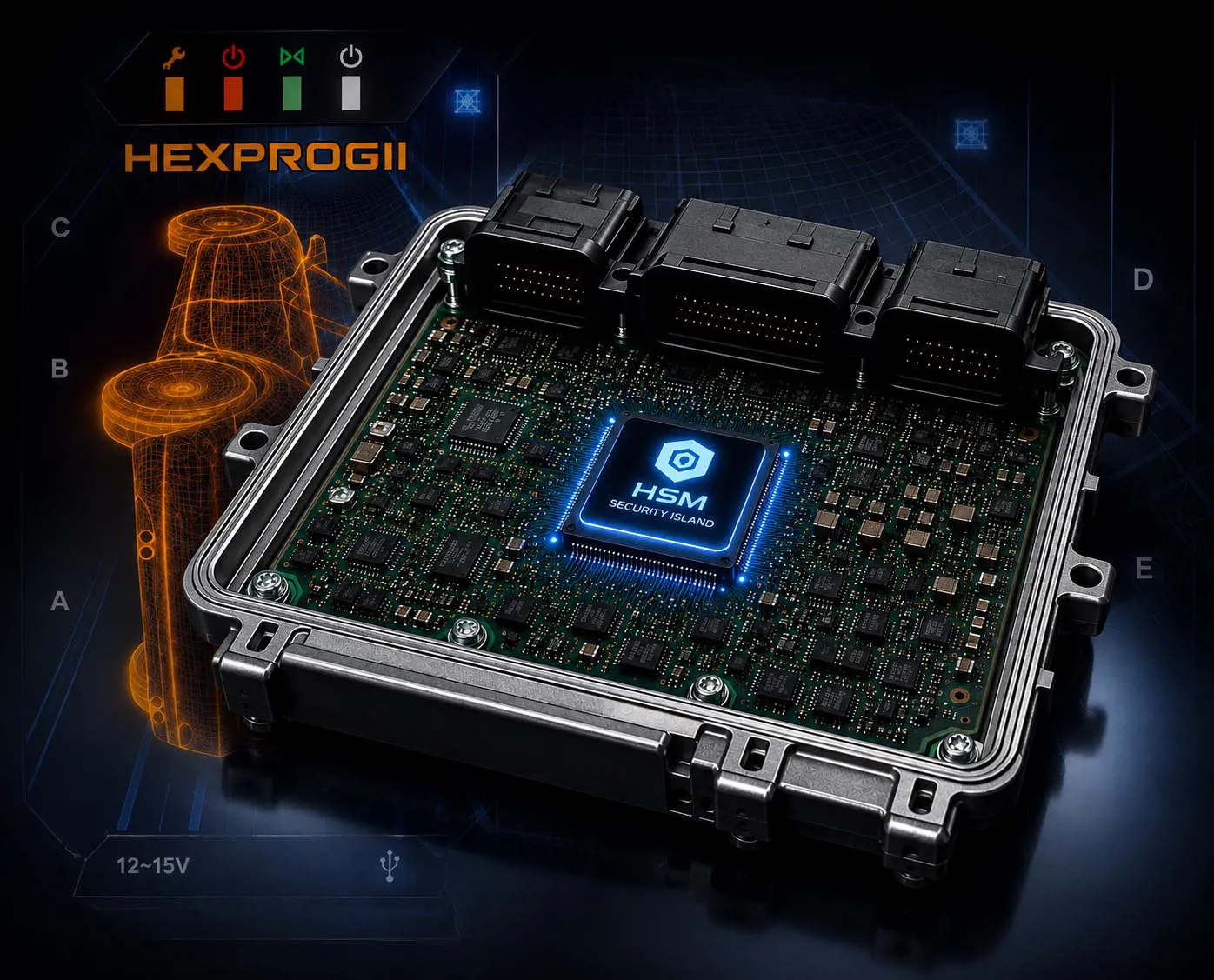
In architectures like the TriCore family found in many powertrain applications, the HSM operates as a physically isolated "security island." It possesses its own independent clock domain, memory space, and cryptographic engines that are separate from the application processor running vehicle logic.
This physical separation ensures that even if the primary operating system is compromised or if unauthorized access attempts occur via standard communication buses, the critical secrets remain protected behind this hardware barrier. The isolation prevents direct readout of sensitive data using external probes because the keys never exist outside the secure boundary where they can be intercepted by conventional means.
Core Functions: Beyond Simple Encryption
While encryption is a well-known aspect of digital security, the role of the HSM extends far beyond simply scrambling data.
To provide accurate technical insight for our users, we must examine several specific functions managed by these modules which directly influence how diagnostic tools interact with the ECU.
- Cryptographic Acceleration and Key Management:
The most fundamental function is providing high-speed processing for complex algorithms such as AES-256, SHA-384, and RSA/ECC.
These operations require significant computational resources to perform efficiently without slowing down real-time engine control tasks. More importantly, the HSM manages the lifecycle of cryptographic keys used for authentication. Unlike older systems where passwords might reside in readable RAM, master keys within an HSM are stored in non-volatile secure storage (often OTP - One Time Programmable fuses) and cannot be exported. They are only available internally to sign commands or verify signatures when requested through authorized interfaces. - Security Access Protocols:
Modern vehicles utilize advanced versions of the standard Diagnostic Communication Protocol (UDS). When attempting to access restricted services like writing calibration data, the tool must undergo a "Security Access" procedure. In legacy ECUs, this was often a simple Seed-Key algorithm that could sometimes be reverse-engineered from static memory dumps. With an active HSM, the challenge-response mechanism becomes dynamic. The vehicle generates a random seed using its internal True Random Number Generator (TRNG), and the response required depends on secrets held exclusively by the security module. This ensures that even if communication traffic is recorded, it cannot be replayed later because each session requires unique cryptographic proof derived from hardware-specific values. - Flash Signature Verification After Programming:
One critical function affecting tuning workflows involves integrity checks after firmware updates. Manufacturers now require that any new software image written to flash memory carries a valid digital signature generated with private vendor keys. Upon completion of programming, the ECU does not immediately execute the code. Instead, the application processor requests the HSM to verify the flash and signature against stored public certificates. If the verification fails meaning the file has been altered without authorization the system will refuse to boot or may enter a safe mode state. This prevents unauthorized modifications but also means that simply overwriting binary files in older methods no longer works; proper authentication sequences are mandatory for successful flashing operations. - Debug Port Protection and Configuration Locking:
Perhaps most relevant to development teams working behind Hexprog II is the management of debug interfaces like JTAG or DAP. Modern MCUs allow manufacturers to fuse these ports into a locked state during production. Once fused, standard debugging commands are ignored unless specific unlock tokens provided through official channels are presented to the HSM. Additionally, configuration registers controlling access levels can be set by the security module itself based on operational modes (e.g., Production Mode vs. Service Mode). These configurations ensure that even if physical pins are accessible, logical barriers prevent deep inspection of internal states without passing cryptographic hurdles managed internally within the chip.
Challenges in Reverse Engineering and Diagnostics
The implementation of robust hardware security introduces distinct challenges when developing diagnostic software compatible with new vehicle models.
For reverse engineers tasked with creating protocols for tools like Hexprog II, the difficulty lies not just in understanding communication layers but in navigating complex handshake procedures enforced at the silicon level.
The primary obstacle remains key isolation. Since master keys cannot be read out via memory dumps, developers must analyze network traffic patterns and protocol behaviors to deduce how valid sessions are established.
This requires extensive testing across different firmware versions because updates often change algorithm parameters while maintaining backward compatibility constraints.
Furthermore, tamper detection mechanisms add another layer of complexity.
Some security islands monitor environmental conditions such as voltage stability and clock frequency accuracy. If anomalies consistent with glitch attacks techniques used historically to bypass checks are detected, the system may trigger a permanent lockout or wipe volatile secrets to protect intellectual property.
While these measures safeguard vehicles against malicious exploitation, they necessitate extreme precision during development phases where legitimate calibration work is performed. Developers must ensure their equipment operates strictly within electrical specifications to avoid triggering false positives on anti-tamper sensors.
Additionally, regulatory frameworks regarding cybersecurity compliance mean that any solution developed must respect legal boundaries concerning access rights and data integrity standards defined by international automotive safety regulations.
Conclusion: Commitment to Overcoming Barriers
Despite the increasing sophistication of Hardware Security Modules and the rigorous barriers placed between diagnostic hardware and vehicle electronics, progress continues unabated.
At Hexprog II, we recognize that modern ECUs present formidable technical challenges compared to previous generations.
However, our engineering team understands exactly what lies behind these "Security Islands." We do not view HSM implementation as an insurmountable wall but rather as a complex puzzle requiring advanced protocol analysis and persistent innovation.
Our commitment remains unwavering: regardless of how manufacturers evolve their cryptographic architectures in TriCore, PowerPC, or other platforms, we will find ways to provide support for new ECUs and TCUs to you, our valued users.
Through continuous research and adaptation, Hexprog II ensures that professional tuning capabilities remain accessible even amidst tightening security landscapes. You can rely on us to deliver compatible solutions that navigate these complexities safely and effectively, keeping your workshop at the forefront of automotive technology without compromising reliability or performance goals.